Special Dates in Blazor DatePicker
14 Aug 20264 minutes to read
You can customize specific dates in the DatePicker by handling the OnRenderDayCell event. This event fires when each day cell is rendered, allowing you to highlight, restyle, or disable specific dates.
@using Syncfusion.Blazor.Calendars
<div class="control-wrapper">
    <SfDatePicker TValue="DateTime?" Placeholder="Choose a Date" ShowClearButton="true" @bind-Value="@SelectedDate">
        <DatePickerEvents TValue="DateTime?" OnRenderDayCell="CustomDates" ValueChange="OnChange"></DatePickerEvents>
    </SfDatePicker>
</div>
<div id="display-date">
    <span>Selected Day : @SelectedValue</span>
</div>
@code {
    public DateTime? SelectedDate { get; set; }
    public string SelectedValue { get; set; } = DateTime.Now.ToString("M/d/yyyy");
    public DateTime? CurrentDate { get; set; } = DateTime.Now;
    public void CustomDates(RenderDayCellEventArgs args)
    {
        if (args.CurrentView == "Month") {
            var CurrentMonth = CurrentDate.Value.Month;
            if (args.Date.Month == CurrentMonth && (args.Date.Day == 7 || args.Date.Day == 14 || args.Date.Day == 24 || args.Date.Day == 29)) {
                args.CellData.ClassList += " personal-appointment";
            }
            if (args.Date.Month == CurrentMonth && (args.Date.Day == 3 || args.Date.Day == 11 || args.Date.Day == 17 || args.Date.Day == 22))
            {
                args.CellData.ClassList += " official-appointment";
            }
        }
    }
    public void OnChange(ChangedEventArgs<DateTime?> args)
    {
        var Count = 0;
        var CurrentMonth = CurrentDate.Value.Month;
        if (args.Value.Value.Month == CurrentMonth && (args.Value.Value.Day == 7 || args.Value.Value.Day == 14 || args.Value.Value.Day == 24 || args.Value.Value.Day == 29))
        {
            this.SelectedValue = this.SelectedDate?.ToString("M/d/yyyy") + " (Personal appointment)";
            Count++;
        }
        if (args.Value.Value.Month == CurrentMonth && (args.Value.Value.Day == 3 || args.Value.Value.Day == 11 || args.Value.Value.Day == 17 || args.Value.Value.Day == 22))
        {
            this.SelectedValue = this.SelectedDate?.ToString("M/d/yyyy") + " (Official appointment)";
            Count++;
        }
        if (Count == 0)
        {
            this.SelectedValue = this.SelectedDate?.ToString("M/d/yyyy");
        }
    }
}
<style>
    #display-date {
        max-width: 270px;
        padding: 15px 0;
        font-size: 13px;
    }
    .control-wrapper {
        width: 300px;
        margin: 0 auto;
        padding-top: 50px;
    }
    .e-calendar .e-content .e-cell.personal-appointment span.e-day,
    .e-calendar .e-content td:hover.e-cell.personal-appointment span.e-day,
    .e-calendar .e-content td.e-selected.e-focused-date.e-cell.personal-appointment span.e-day {
        color: #28a745;
        font-weight: 800;
    }
    .e-calendar .e-content .e-cell.official-appointment span.e-day,
    .e-calendar .e-content td:hover.e-cell.official-appointment span.e-day,
    .e-calendar .e-content td.e-selected.e-focused-date.e-cell.official-appointment span.e-day {
        color: #dc3545;
        font-weight: 800;
    }
    .e-calendar .e-content td.e-selected.e-focused-date.e-cell.personal-appointment span.e-day,
    .e-calendar .e-content td.e-selected.e-focused-date.e-cell.official-appointment span.e-day {
        background-color: #b511485e;
    }
</style>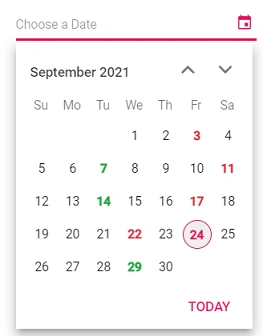
NOTE
The
RenderDayCellEventArgsincludes aCurrentViewproperty that identifies the active calendar view during rendering. Possible values areMonth,Year, andDecade. Use this to apply view-specific logic within the OnRenderDayCell handler. This property is useful for customizing the rendering of day cells based on the calendar’s current view.