Data Binding in Blazor ListBox
18 Aug 20268 minutes to read
The Blazor ListBox loads data from local or remote sources using the DataSource property, which accepts an IEnumerable<TItem>. The fields used to display each item and to map it to a unique value are configured through the ListBoxFieldSettings child component.
| Fields | Type | Description |
|---|---|---|
| Text | string |
Specifies the display text of each list item. |
| Value | string |
Specifies the hidden data value mapped to each list item and should be unique. |
| GroupBy | string |
Specifies the category under which each list item is grouped. |
| IconCss | string |
Specifies the CSS class for an icon to display with the item. |
| HtmlAttributes | string |
Specifies additional HTML attributes to configure item elements. |
| Disabled | string |
Specifies the boolean property (or a property returning "true"/"false") that indicates whether the item is disabled. |
When binding complex data to the ListBox, map fields correctly. If the mapping is incorrect, selection and value binding may not work as expected.
Local Data
Local data can be provided in the following ways.
Array of string
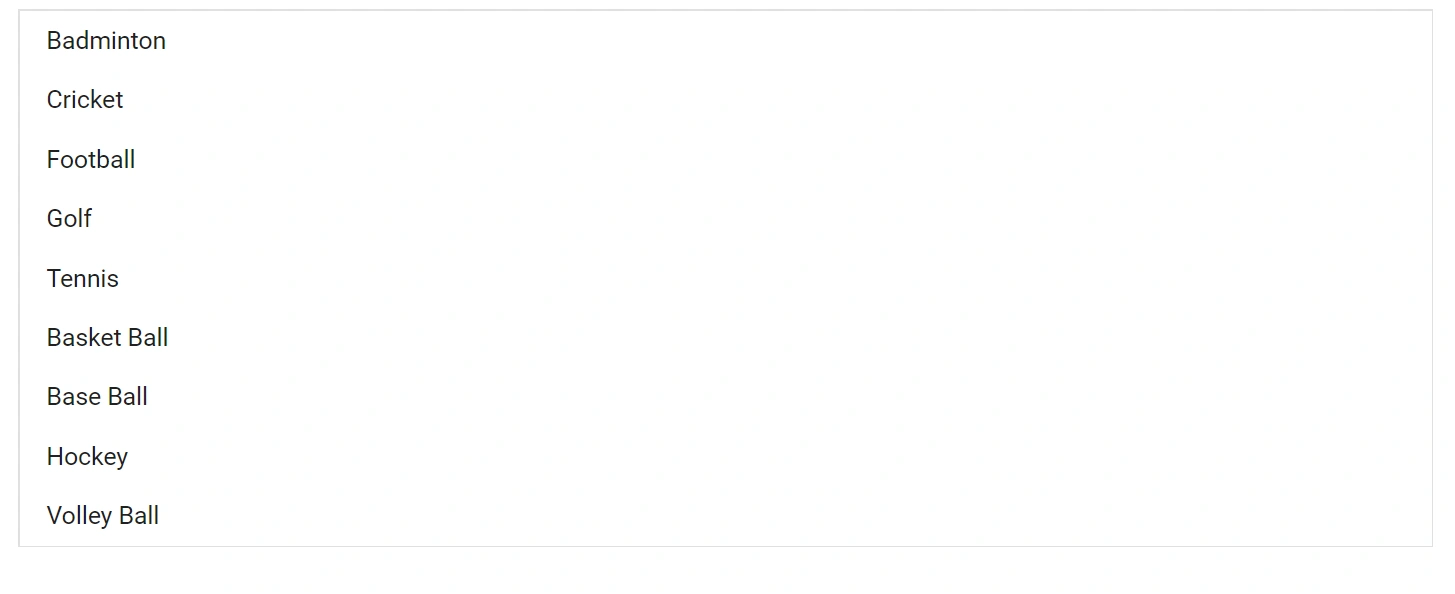
The ListBox supports arrays of primitive values such as strings or numbers. In this case, both the Text and Value fields resolve to the same value.
@using Syncfusion.Blazor.DropDowns

<SfListBox TValue="string[]" DataSource="@Games" TItem="string"></SfListBox>

@code {
    public string[] Games = new string[] { "Badminton", "Cricket", "Football", "Golf", "Tennis", "Basket Ball", "Base Ball", "Hockey", "Volley Ball" };
}
Array of object
The ListBox can generate its list items from an array of objects. Map the Text and Value properties of the objects to the corresponding fields in ListBoxFieldSettings.
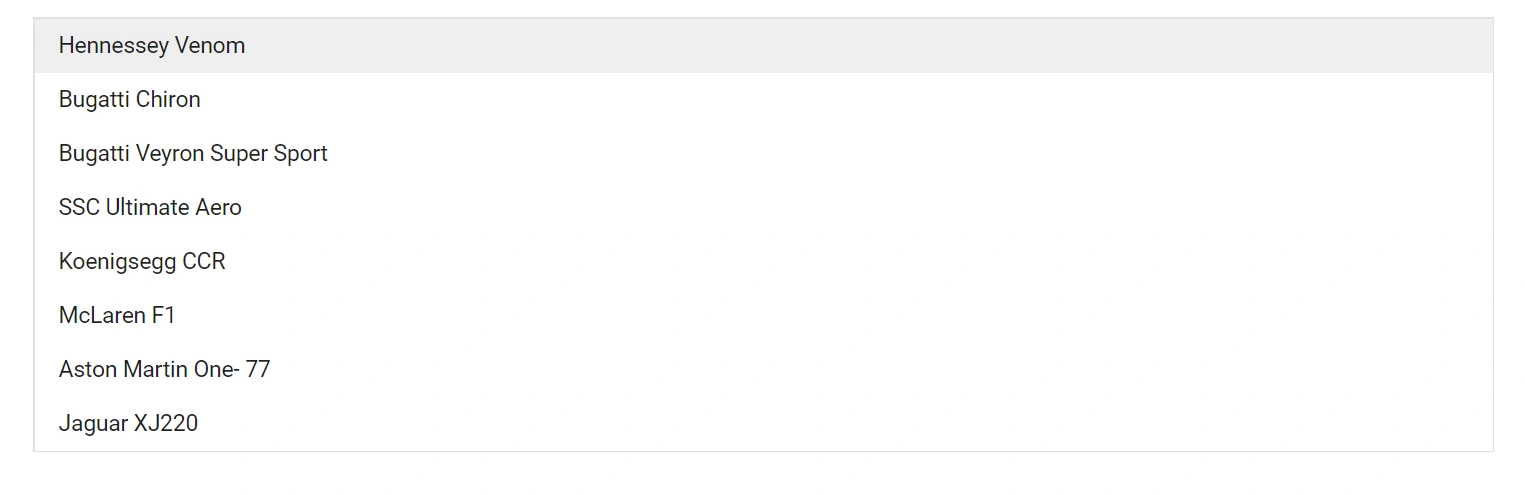
In the following example, the Text property is mapped to the Text field and the Id property is mapped to the Value field.
@using Syncfusion.Blazor.DropDowns

<SfListBox TValue="string[]" DataSource="@Vehicles" TItem="VehicleData">
    <ListBoxFieldSettings Text="Text" Value="Id" />
</SfListBox>

@code {
    public List<VehicleData> Vehicles = new List<VehicleData> {
        new VehicleData { Text = "Hennessey Venom", Id = "Vehicle-01" },
        new VehicleData { Text = "Bugatti Chiron", Id = "Vehicle-02" },
        new VehicleData { Text = "Bugatti Veyron Super Sport", Id = "Vehicle-03" },
        new VehicleData { Text = "SSC Ultimate Aero", Id = "Vehicle-04" },
        new VehicleData { Text = "Koenigsegg CCR", Id = "Vehicle-05" },
        new VehicleData { Text = "McLaren F1", Id = "Vehicle-06" },
        new VehicleData { Text = "Aston Martin One-77", Id = "Vehicle-07" },
        new VehicleData { Text = "Jaguar XJ220", Id = "Vehicle-08" }
    };

    public class VehicleData {
        public string Text { get; set; }
        public string Id { get; set; }
    }
}
Array of complex object
The ListBox can generate items from an array of complex objects. Map nested properties (using dot notation) to the corresponding fields in ListBoxFieldSettings.
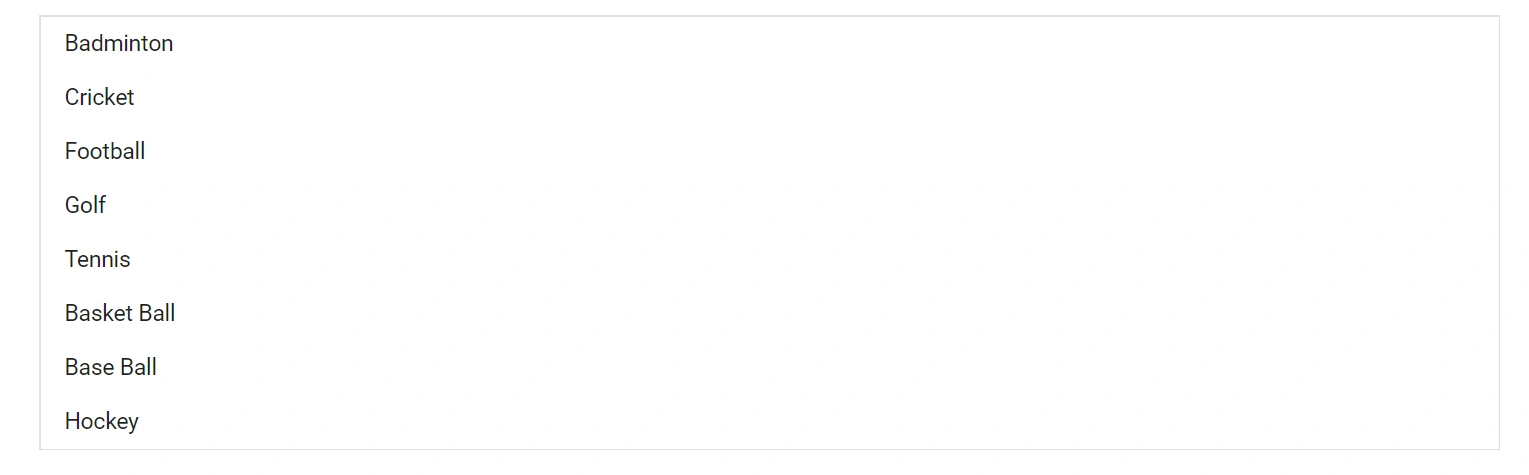
In the following example, the Sports.Name property from the complex data is mapped to the Text field.
@using Syncfusion.Blazor.DropDowns

<SfListBox TValue="string[]" DataSource="@SportsDetails" TItem="SportsData">
    <ListBoxFieldSettings Text="Sports.Name" Value="Id" />
</SfListBox>

@code {
    public List<SportsData> SportsDetails = new List<SportsData>
    {
        new SportsData { Id = "game0", Sports = new GameData { Name = "Badminton" } },
        new SportsData { Id = "game1", Sports = new GameData { Name = "Cricket" } },
        new SportsData { Id = "game2", Sports = new GameData { Name = "Football" } },
        new SportsData { Id = "game3", Sports = new GameData { Name = "Golf" } },
        new SportsData { Id = "game4", Sports = new GameData { Name = "Tennis" } },
        new SportsData { Id = "game5", Sports = new GameData { Name = "Basket Ball" } },
        new SportsData { Id = "game6", Sports = new GameData { Name = "Base Ball" } },
        new SportsData { Id = "game7", Sports = new GameData { Name = "Hockey" } }
    };

    public class GameData {
        public string Name { get; set; }
    }

    public class SportsData {
        public string Id { get; set; }
        public GameData Sports { get; set; }
    }
}
Pre-selecting items using the Value parameter
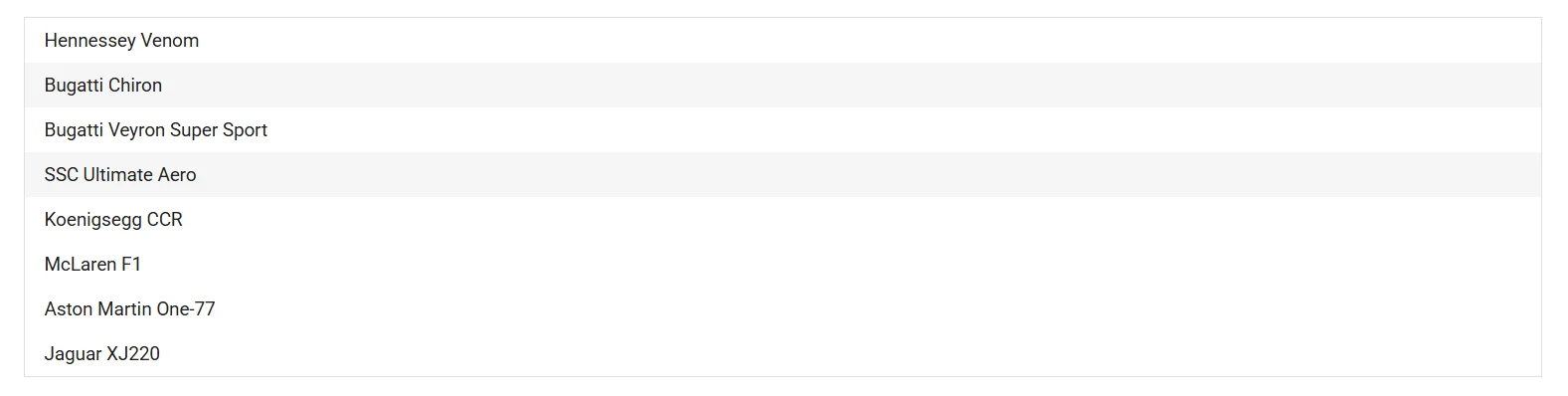
The ListBox supports pre-selecting items when the component renders by binding an array of values through the Value parameter. The values supplied must match the field mapped to ListBoxFieldSettings.Value. Use the @bind-Value directive to keep the bound variable in sync with the user’s selection.
The following example demonstrates how to bind an array of selected values to the ListBox.
@using Syncfusion.Blazor.DropDowns

<SfListBox TValue="string[]" DataSource="@Vehicles" TItem="VehicleData" @bind-Value="@SelectedValues">
    <ListBoxFieldSettings Text="Text" Value="Id" />
</SfListBox>

@code {
    public string[] SelectedValues = new string[] { "Vehicle-02", "Vehicle-04" };

    public List<VehicleData> Vehicles = new List<VehicleData> {
        new VehicleData { Text = "Hennessey Venom", Id = "Vehicle-01" },
        new VehicleData { Text = "Bugatti Chiron", Id = "Vehicle-02" },
        new VehicleData { Text = "Bugatti Veyron Super Sport", Id = "Vehicle-03" },
        new VehicleData { Text = "SSC Ultimate Aero", Id = "Vehicle-04" },
        new VehicleData { Text = "Koenigsegg CCR", Id = "Vehicle-05" },
        new VehicleData { Text = "McLaren F1", Id = "Vehicle-06" },
        new VehicleData { Text = "Aston Martin One-77", Id = "Vehicle-07" },
        new VehicleData { Text = "Jaguar XJ220", Id = "Vehicle-08" }
    };

    public class VehicleData {
        public string Text { get; set; }
        public string Id { get; set; }
    }
}
Remote Data
The ListBox supports retrieving data from remote services by setting the DataManager component as a child of SfListBox.
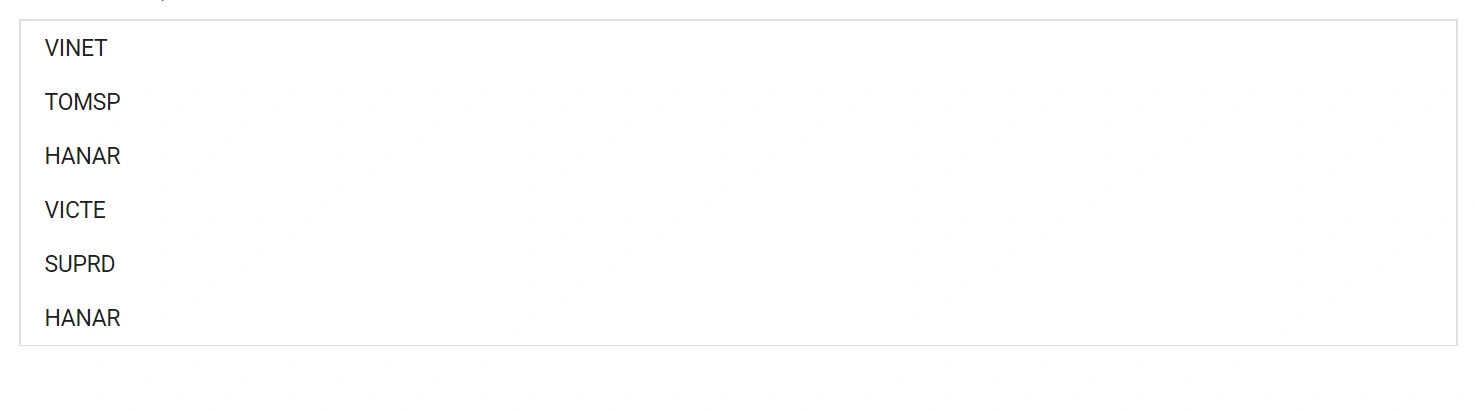
The following example displays customer IDs from the Orders table.
@using Syncfusion.Blazor.Data
@using Syncfusion.Blazor.DropDowns

<SfListBox TValue="string[]" TItem="OrderDetails" Query="@RemoteDataQuery">
    <SfDataManager Url="https://services.odata.org/V4/Northwind/Northwind.svc/Orders" Adaptor="Syncfusion.Blazor.Adaptors.ODataV4Adaptor" CrossDomain="true"></SfDataManager>
    <ListBoxFieldSettings Text="CustomerID" Value="CustomerID" />
</SfListBox>

@code {
    public Query RemoteDataQuery = new Query().Select(new List<string> { "CustomerID" }).Take(6).RequiresCount();

    public class OrderDetails
    {
        public int? OrderID { get; set; }
        public string CustomerID { get; set; }
        public int? EmployeeID { get; set; }
        public double? Freight { get; set; }
        public string ShipCity { get; set; }
        public bool Verified { get; set; }
        public DateTime? OrderDate { get; set; }
        public string ShipName { get; set; }
        public string ShipCountry { get; set; }
        public DateTime? ShippedDate { get; set; }
        public string ShipAddress { get; set; }
    }
}