Data Binding in Blazor DataManager Component
1 Jul 20264 minutes to read
Data binding establishes a connection between a Blazor component and its data source. The Blazor DataManager component provides an efficient way to manage this connection. It acts as an intermediary between the data source and UI components such as SfGrid.
The SfDataManager supports two primary approaches for data binding:
-
Local Data Binding – Binds in-memory collections directly to the component using the Json property.
-
Remote Data Binding – Connects to remote services by specifying a service endpoint URL and configuring the Adaptor property.
Built-in adaptors enable seamless integration with services such as OData and Web API. Common operations like filtering, sorting, paging, and grouping can be executed on the client or server based on the selected adaptor.
Local data binding
Local data binding connects a component to data that resides in the application’s memory. This approach is suitable when the dataset is already available and does not require frequent updates from an external source.
Key Benefits
- Eliminates network latency.
- Ideal for small to medium sized collections.
- Simplifies configuration since no remote service is involved.
- Operations such as sorting, filtering, paging, and grouping are performed entirely on the client.
To configure local data binding, assign the in-memory collection to the Json property of the SfDataManager component.
@using Syncfusion.Blazor.Data
@using Syncfusion.Blazor.Grids

<SfGrid TValue="EmployeeData" ID="Grid">
    <SfDataManager Json="@Employees"></SfDataManager>
    <GridColumns>
        <GridColumn Field="@nameof(EmployeeData.EmployeeID)" HeaderText="Employee ID" TextAlign="TextAlign.Center" Width="120"></GridColumn>
        <GridColumn Field="@nameof(EmployeeData.Name)" HeaderText="First Name" Width="130"></GridColumn>
        <GridColumn Field="@nameof(EmployeeData.Title)" HeaderText="Title" Width="120"></GridColumn>
    </GridColumns>
</SfGrid>

@code {

    public class EmployeeData
    {
        public int EmployeeID { get; set; }
        public string Name { get; set; }
        public string Title { get; set; }
    }

    private List<EmployeeData> Employees { get; set; } = new()
    {
        new EmployeeData { EmployeeID = 1, Name = "Nancy Fuller", Title = "Vice President" },
        new EmployeeData { EmployeeID = 2, Name = "Steven Buchanan", Title = "Sales Manager" },
        new EmployeeData { EmployeeID = 3, Name = "Janet Leverling", Title = "Sales Representative" },
        new EmployeeData { EmployeeID = 4, Name = "Andrew Davolio", Title = "Inside Sales Coordinator" },
        new EmployeeData { EmployeeID = 5, Name = "Steven Peacock", Title = "Inside Sales Coordinator" },
        new EmployeeData { EmployeeID = 6, Name = "Janet Buchanan", Title = "Sales Representative" },
        new EmployeeData { EmployeeID = 7, Name = "Andrew Fuller", Title = "Inside Sales Coordinator" },
        new EmployeeData { EmployeeID = 8, Name = "Steven Davolio", Title = "Inside Sales Coordinator" },
        new EmployeeData { EmployeeID = 9, Name = "Janet Davolio", Title = "Sales Representative" },
        new EmployeeData { EmployeeID = 10, Name = "Andrew Buchanan", Title = "Sales Representative" }
    };
}
Remote data binding
Remote data binding connects a component to data hosted on an external service. This approach is recommended when working with large datasets or when data changes frequently and must be retrieved dynamically.
Key Benefits
- Enables integration with external services and APIs.
- Supports large-scale datasets without loading all data into memory.
- Allows server-side execution of operations such as filtering, sorting, paging, and grouping for improved performance.
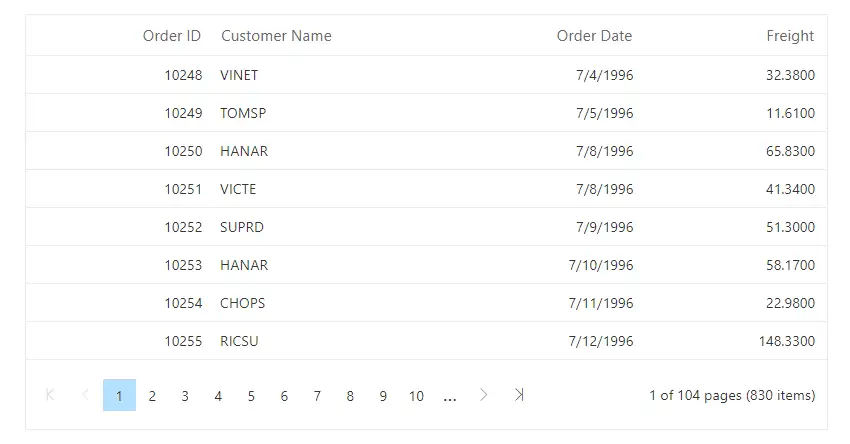
To configure remote data binding in the DataGrid, set the Url property to the service endpoint and specify the Adaptor property in the SfDataManager component to define how data operations are processed.
@using Syncfusion.Blazor
@using Syncfusion.Blazor.Data
@using Syncfusion.Blazor.Grids

<SfGrid TValue="Order" ID="Grid" AllowPaging="true">
    <SfDataManager Url="https://js.syncfusion.com/demos/ejServices/Wcf/Northwind.svc/Orders" Adaptor="Adaptors.ODataAdaptor"></SfDataManager>
    <GridColumns>
        <GridColumn Field="@nameof(Order.OrderID)" HeaderText="Order ID" IsPrimaryKey="true" TextAlign="TextAlign.Right" Width="120"></GridColumn>
        <GridColumn Field="@nameof(Order.CustomerID)" HeaderText="Customer Name" Width="150"></GridColumn>
        <GridColumn Field="@nameof(Order.OrderDate)" HeaderText="Order Date" Format="d" Type="ColumnType.Date" TextAlign="TextAlign.Right" Width="130"></GridColumn>
        <GridColumn Field="@nameof(Order.Freight)" HeaderText="Freight" Format="C2" TextAlign="TextAlign.Right" Width="120"></GridColumn>
    </GridColumns>
</SfGrid>

@code {
    public class Order
    {
        public int? OrderID { get; set; }
        public string CustomerID { get; set; }
        public DateTime? OrderDate { get; set; }
        public double? Freight { get; set; }
    }
}