Getting Started with Blazor Block Editor Component
16 Dec 20259 minutes to read
This section briefly explains about how to include Blazor Block Editor component in your Blazor WebAssembly App using Visual Studio, Visual Studio Code, and the .NET CLI.
Prerequisites
Create a new Blazor App in Visual Studio
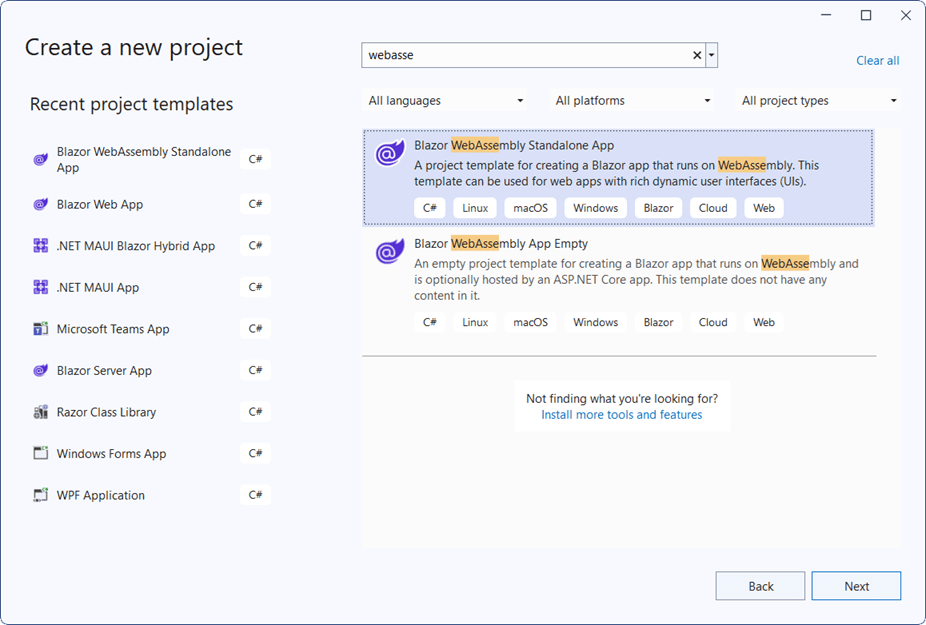
Create a Blazor WebAssembly App using Visual Studio via Microsoft Templates or the Syncfusion® Blazor Extension. For detailed instructions, refer to the Blazor WASM App Getting Started documentation.
Install Syncfusion® Blazor BlockEditor and Themes NuGet in the App
To add the Blazor Block Editor component in the app, open the NuGet package manager in Visual Studio (Tools → NuGet Package Manager → Manage NuGet Packages for Solution), then search and install Syncfusion.Blazor.BlockEditor and Syncfusion.Blazor.Themes. Alternatively, run the following commands in the Package Manager Console to achieve the same.
Install-Package Syncfusion.Blazor.BlockEditor -Version 32.1.19
Install-Package Syncfusion.Blazor.Themes -Version 32.1.19
NOTE
Syncfusion® Blazor components are available in nuget.org. Refer to the NuGet packages topic for the available NuGet packages list with component details.
Prerequisites
Create a new Blazor App in Visual Studio Code
Create a Blazor WebAssembly App using Visual Studio Code via Microsoft Templates or the Syncfusion® Blazor Extension. For detailed instructions, refer to the Blazor WASM App Getting Started documentation.
Alternatively, create a WebAssembly application by using the following command in the integrated terminal(Ctrl+`).
dotnet new blazorwasm -o BlazorApp
cd BlazorApp
Install Syncfusion® Blazor BlockEditor and Themes NuGet in the App
- Press Ctrl+` to open the integrated terminal in Visual Studio Code.
- Ensure you’re in the project root directory where your
.csprojfile is located. - Run the following command to install a
Syncfusion.Blazor.BlockEditorand Syncfusion.Blazor.Themes NuGet package and ensure all dependencies are installed.
dotnet add package Syncfusion.Blazor.BlockEditor -v 32.1.19
dotnet add package Syncfusion.Blazor.Themes -v 32.1.19
dotnet restore
NOTE
Syncfusion® Blazor components are available in nuget.org. Refer to the NuGet packages topic for the available NuGet packages list with component details.
Prerequisites
Install the latest version of .NET SDK. If the .NET SDK was previously installed, determine the installed version by running the following command in a command prompt (Windows), terminal (macOS), or command shell (Linux).
dotnet --versionCreate a Blazor WebAssembly App using .NET CLI
Run the following command to create a new Blazor WebAssembly App in a command prompt (Windows) or terminal (macOS) or command shell (Linux). For detailed instructions, refer to this Blazor WASM App Getting Started documentation.
dotnet new blazorwasm -o BlazorApp
cd BlazorApp
Install Syncfusion® Blazor BlockEditor and Themes NuGet in the App
To add the Blazor Block Editor component to the application, run the following commands in a command prompt (Windows), command shell (Linux), or terminal (macOS) to install the Syncfusion.Blazor.BlockEditor and Syncfusion.Blazor.Themes NuGet packages. See Install and manage packages using the dotnet CLI for more details.
dotnet add package Syncfusion.Blazor.BlockEditor -Version 32.1.19
dotnet add package Syncfusion.Blazor.Themes -Version 32.1.19
dotnet restore
NOTE
Syncfusion® Blazor components are available in nuget.org. Refer to the NuGet packages topic for the available NuGet packages list with component details.
Add Import Namespaces
Open the ~/_Imports.razor file and import the Syncfusion.Blazor and Syncfusion.Blazor.BlockEditor namespaces.
@using Syncfusion.Blazor
@using Syncfusion.Blazor.BlockEditor
Register Syncfusion® Blazor Service
Register the Syncfusion® Blazor Service in the ~/Program.cs file of the Blazor WebAssembly App.
using Microsoft.AspNetCore.Components.Web;
using Microsoft.AspNetCore.Components.WebAssembly.Hosting;
using Syncfusion.Blazor;

var builder = WebAssemblyHostBuilder.CreateDefault(args);
builder.RootComponents.Add<App>("#app");
builder.RootComponents.Add<HeadOutlet>("head::after");

builder.Services.AddScoped(sp => new HttpClient { BaseAddress = new Uri(builder.HostEnvironment.BaseAddress) });

builder.Services.AddSyncfusionBlazor();
await builder.Build().RunAsync();
....
Add stylesheet and script resources
The theme stylesheet and script can be accessed from NuGet through Static Web Assets. Include the stylesheet and script references within the <head> section of the ~/index.html file.
<head>
    ....
    <link href="_content/Syncfusion.Blazor.Themes/bootstrap5.css" rel="stylesheet" />
    <script src="_content/Syncfusion.Blazor.Core/scripts/syncfusion-blazor.min.js" type="text/javascript"></script>
</head>
NOTE
Check out the Blazor Themes topic to discover various methods (Static Web Assets, CDN, and CRG) for referencing themes in your Blazor application. Also, check out the Adding Script Reference topic to learn different approaches for adding script references in your Blazor application.
Add Blazor Block Editor component
Add the Syncfusion® Blazor Block Editor component in the ~/Pages/Index.razor file.
<SfBlockEditor Blocks="blockDataOverview">
</SfBlockEditor>

@code {
    private List<BlockModel> blockDataOverview = new EditorBlockData().GetBlockDataOverview();

    public class EditorBlockData
    {
        public List<BlockModel> GetBlockDataOverview()
        {
            List<BlockModel> blockDataOverview = new List<BlockModel>
            {
                new BlockModel
                {
                    BlockType = BlockType.Heading,
                    Properties = new HeadingBlockSettings{ Level=2 },
                    Content =
                    {
                        new ContentModel
                        {
                            ContentType = ContentType.Text,
                            Content = "Getting Started with Block Editor"
                        }
                    }
                },
                new BlockModel
                {
                    BlockType = BlockType.Paragraph,
                    Content =
                    {
                        new ContentModel { ContentType=ContentType.Text, Content="Welcome to" },
                        new ContentModel { ContentType=ContentType.Text, Content=" Block Editor", Properties=new TextContentSettings{ Styles = new StyleModel{ Bold = true } } },
                        new ContentModel { ContentType=ContentType.Text, Content=" - your flexible, modular workspace for creating rich, structured content. whether you're drafting documents, brainstorming ideas, or collaborating with your team, Block Editor makes it simple and intuitive." }
                    }
                },
                new BlockModel{ BlockType = BlockType.Paragraph, Content = new List<ContentModel>() }
            };
            return blockDataOverview;
        }
    }
}
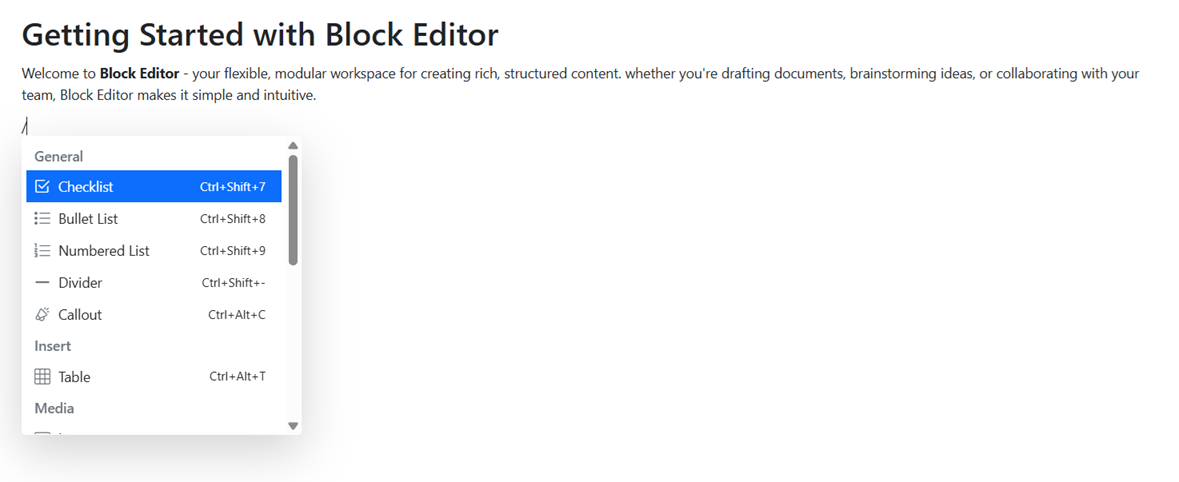
Press Ctrl+F5 (Windows) or ⌘+F5 (macOS) to launch the application. This will render the Syncfusion® Blazor Block Editor component in the default web browser.