Getting Started with Diagram Component in the Blazor WASM App
9 Jul 202612 minutes to read
This section explains the step-by-step process for integrating the Blazor Diagram component into a Blazor WebAssembly App using Visual Studio, Visual Studio Code, and the .NET CLI. We’ll break it down into simple steps to make it easy to follow. Additionally, you can find a fully functional example project on our GitHub repository.
Ready to streamline your Blazor development?
Discover the full potential of Blazor components with AI Coding Assistants. Effortlessly integrate, configure, and enhance your projects with intelligent, context-aware code suggestions, streamlined setups, and real-time insights—all seamlessly integrated into your preferred AI-powered IDEs like VS Code, Cursor, CodeStudio and more. Explore AI Coding Assistants
Prerequisites
Create a new Blazor App in Visual Studio
Create a Blazor WebAssembly App using Visual Studio via Microsoft Templates or the Syncfusion® Blazor Extension. For detailed instructions, refer to the Blazor WebAssembly Getting Started documentation.
Prerequisites
Create a new Blazor App in Visual Studio Code
Create a Blazor WebAssembly App using Visual Studio Code via Microsoft Templates or the Syncfusion® Blazor Extension. For detailed instructions, refer to the Blazor WebAssembly Getting Started documentation.
Prerequisites
Install the latest version of .NET SDK. If the .NET SDK is already installed, determine the installed version by running the following command in a command prompt (Windows), terminal (macOS), or command shell (Linux).
dotnet --versionCreate a Blazor WebAssembly App using .NET CLI
Run the following command to create a new Blazor WebAssembly App in a command prompt (Windows) or terminal (macOS) or command shell (Linux). For detailed instructions, refer to the Blazor WASM App Getting Started documentation.
dotnet new blazorwasm -o BlazorApp
cd BlazorApp
This command creates a new Blazor WebAssembly App and places it in a new directory called BlazorApp inside your current location.
Install required Blazor packages
Install Syncfusion.Blazor.Diagram and Syncfusion.Blazor.Themes NuGet packages in your project using the NuGet Package Manager in Visual Studio (Tools → NuGet Package Manager → Manage NuGet Packages for Solution → Select the package -> Install).
Alternatively, run the following commands in the Package Manager Console(Tools → NuGet Package Manager → Package Manager Console) to achieve the same.
Install-Package Syncfusion.Blazor.Diagram -Version 34.1.29
Install-Package Syncfusion.Blazor.Themes -Version 34.1.29
Install Syncfusion.Blazor.Diagram and Syncfusion.Blazor.Themes NuGet packages in your project using the C# package management(Right click the “.csproj” file, -> C# package management -> Add nuget package -> Select nuget package and version)
Install Syncfusion.Blazor.Diagram and Syncfusion.Blazor.Themes NuGet packages in your project using the .NET CLI command.
dotnet add package Syncfusion.Blazor.Diagram --version 34.1.29
dotnet add package Syncfusion.Blazor.Themes --version 34.1.29
NOTE
All Syncfusion Blazor packages are available on nuget.org. See the NuGet packages topic for details.
Add import namespaces
After the packages are installed, open the ~/_Imports.razor file and import the Syncfusion.Blazor and Syncfusion.Blazor.Diagram namespaces.
@using Syncfusion.Blazor;
@using Syncfusion.Blazor.Diagram;
Register Blazor service
Register the Blazor service in the Program.cs file of your Blazor WebAssembly App.
....
using Syncfusion.Blazor;
....
var builder = WebApplication.CreateBuilder(args);
builder.Services.AddSyncfusionBlazor();
....
Add stylesheet and script resources
The theme stylesheet and script can be accessed from NuGet through Static Web Assets. Include the stylesheet and script references in the ~wwwroot/index.html file.
<head>
    ...
    <link href="_content/Syncfusion.Blazor.Themes/fluent2.css" rel="stylesheet" />
</head>
<body>
    ....
    <script src="_content/Syncfusion.Blazor.Diagram/scripts/sf-diagramcomponent.min.js" type="text/javascript"></script>
</body>
NOTE
Check out the Blazor Themes topic to discover various methods (Static Web Assets, CDN, and CRG) for referencing themes in the Blazor application. Also, check out the Adding Script Reference topic to learn different approaches for adding script references in the Blazor application.
Add Blazor Diagram component
Add the DiagramComponent to create an empty diagram.
<SfDiagramComponent Width="100%" Height="600px"/>Create your first Diagram with nodes and connectors
This section explains how to create a simple flowchart by adding nodes, customizing their appearance, and connecting them using connectors.
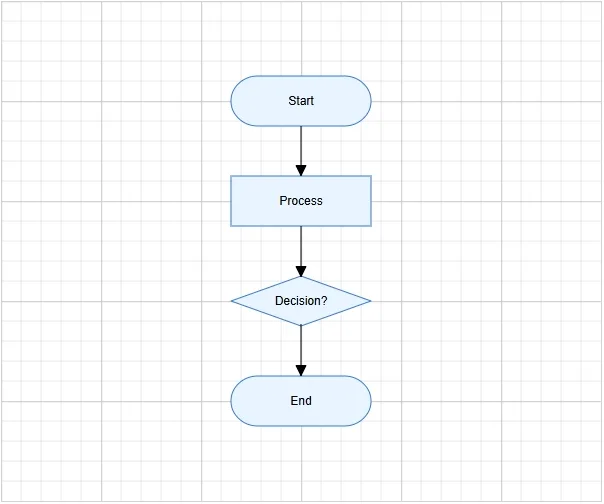
The following example creates a flowchart with four nodes: Start, Process, Decision, and End. It also applies common node and connector settings using the NodeCreating and ConnectorCreating properties.
<SfDiagramComponent Width="100%" Height="600px" Nodes="@nodes" Connectors="@connectors" NodeCreating="@NodeCreating" ConnectorCreating="@ConnectorCreating" />

@code {
    DiagramObjectCollection<Node> nodes = new DiagramObjectCollection<Node>();
    DiagramObjectCollection<Connector> connectors = new DiagramObjectCollection<Connector>();
    protected override void OnInitialized()
    {
        nodes = new DiagramObjectCollection<Node>()
        {
            new Node()
            {
               ID = "node1", OffsetX = 300, OffsetY = 100,
               Shape = new FlowShape() { Type = NodeShapes.Flow, Shape = NodeFlowShapes.Terminator },
               Annotations = new DiagramObjectCollection<ShapeAnnotation>()
               {
                  new ShapeAnnotation(){ Content = "Start" }
               }
            },
            new Node()
            {
               ID = "node2", OffsetX = 300, OffsetY = 200,
               Shape = new FlowShape() { Type = NodeShapes.Flow, Shape = NodeFlowShapes.Process },
               Annotations = new DiagramObjectCollection<ShapeAnnotation>()
               {
                  new ShapeAnnotation(){ Content = "Process" }
               }
            },
            new Node()
            {
               ID = "node3", OffsetX = 300, OffsetY = 300,
               Shape = new FlowShape() { Type = NodeShapes.Flow, Shape = NodeFlowShapes.Decision },
               Annotations = new DiagramObjectCollection<ShapeAnnotation>()
               {
                  new ShapeAnnotation(){ Content = "Decision?" }
               }
            },
            new Node()
            {
               ID = "node4", OffsetX = 300, OffsetY = 400,
               Shape = new FlowShape() { Type = NodeShapes.Flow, Shape = NodeFlowShapes.Terminator },
               Annotations = new DiagramObjectCollection<ShapeAnnotation>()
               {
                  new ShapeAnnotation(){ Content = "End" }
               }
            }
        };
        connectors = new DiagramObjectCollection<Connector>()
        {
            new Connector()
            {
                ID = "connector1",
                SourceID = "node1",
                TargetID = "node2",
            },
            new Connector()
            {
                ID = "connector2",
                SourceID = "node2",
                TargetID = "node3",
            },
            new Connector()
            {
                ID = "connector2",
                SourceID = "node3",
                TargetID = "node4",
            },
        };
    }

    private void NodeCreating(IDiagramObject obj)
    {
        Node node = obj as Node;
        node.Style = new ShapeStyle() { Fill = "#E8F4FF", StrokeColor = "#357BD2" };
        node.Width = 140;
        node.Height = 50;
    }

    private void ConnectorCreating(IDiagramObject obj)
    {
        (obj as Connector).Type = ConnectorSegmentType.Orthogonal;
    }
}
In this example:
-
OffsetXandOffsetYdefine the position of each node. -
Shapedefines the node shape configuration, andFlowShape.Shapespecifies flowchart shapes such as Terminator, Process, or Decision. -
ShapeAnnotationadds text inside each node using theContentproperty. -
SourceIDandTargetIDconnect one node to another. -
NodeCreatingapplies common width, height, fill color, and stroke color to all nodes. -
ConnectorCreatingapplies common connector settings, such as orthogonal routing.
Run the application
- Press Ctrl+F5 (Windows) or ⌘+F5 (macOS) to launch the application in Visual Studio.
- Run the application using
dotnet runcommand in Command prompt. - This will render the Blazor Diagram component in the default web browser.
The output will appear as follows: