Getting Started with Blazor TimePicker in Blazor WASM App
14 Aug 20265 minutes to read
This section briefly explains how to include Blazor TimePicker component in a Blazor WebAssembly App using Visual Studio, Visual Studio Code, and the .NET CLI.
Create a new Blazor WASM App
Create a Blazor WebAssembly App using Visual Studio via Microsoft Templates or the Syncfusion® Blazor Extension. For detailed instructions, refer to the Blazor WebAssembly App Getting Started documentation.
Run the following command to create a new Blazor WebAssembly App.
dotnet new blazorwasm -o BlazorApp
cd BlazorApp
Alternatively, create a Blazor WebAssembly App using Visual Studio Code via Microsoft Templates, the Syncfusion® Blazor Extension, or the C# Dev Kit extension.
Run the following command to create a new Blazor WebAssembly App.
dotnet new blazorwasm -o BlazorApp
cd BlazorApp
Install the required Blazor packages
Install Syncfusion.Blazor.Calendars and Syncfusion.Blazor.Themes NuGet packages. All Syncfusion Blazor packages are available on nuget.org. See the NuGet packages topic for details.
- Go to Tools → NuGet Package Manager → Manage NuGet Packages for Solution.
- Search the required NuGet packages (
Syncfusion.Blazor.CalendarsandSyncfusion.Blazor.Themes) and install them.
Alternatively, you can install the same packages using the Package Manager Console with the following commands.
Install-Package Syncfusion.Blazor.Calendars -Version 34.2.2
Install-Package Syncfusion.Blazor.Themes -Version 34.2.2
Open the terminal and run the following commands.
dotnet add package Syncfusion.Blazor.Calendars -v 34.2.2
dotnet add package Syncfusion.Blazor.Themes -v 34.2.2
Open the command prompt and run the following commands.
dotnet add package Syncfusion.Blazor.Calendars -v 34.2.2
dotnet add package Syncfusion.Blazor.Themes -v 34.2.2
Add import namespaces
After the packages are installed, open the ~/_Imports.razor file and import the Syncfusion.Blazor and Syncfusion.Blazor.Calendars namespaces.
@using Syncfusion.Blazor
@using Syncfusion.Blazor.Calendars
Register the Blazor service
Open the Program.cs file in the Blazor WebAssembly App and register the Blazor service.
....
using Syncfusion.Blazor;
....
builder.Services.AddSyncfusionBlazor();
....
Add stylesheet and script resources
The theme stylesheet and script can be accessed from NuGet through Static Web Assets. Include the stylesheet and script references in the ~wwwroot/index.html file.
...
<link href="_content/Syncfusion.Blazor.Themes/fluent2.css" rel="stylesheet" />
...
<script src="_content/Syncfusion.Blazor.Core/scripts/syncfusion-blazor.min.js" type="text/javascript"></script>
Add Blazor TimePicker component
Open a Razor file located in the ~/Pages/*.razor (for example, Home.razor) and add the Blazor TimePicker component inside the razor file.
@using Syncfusion.Blazor.Calendars

<SfTimePicker TValue="DateTime?" PlaceHolder="Select a time"></SfTimePicker>
Run the application
Press Ctrl+F5 (Windows) or ⌘+F5 (macOS) to launch the application. The Blazor TimePicker component will render in your default web browser.
Open the terminal and run the following command.
dotnet runOpen the command prompt and run the following command.
dotnet run
Setting the time format
Time format is a way of representing the time value in different string formats in the textbox and popup list. By default, the TimePicker’s Format is based on the culture. The TimePicker format can be customized using the Format property.
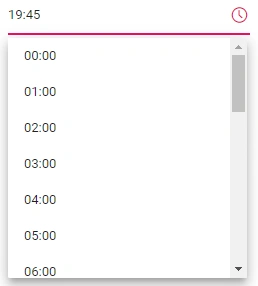
The below code demonstrates how to render TimePicker component in 24 hours format with 60 minutes interval. The time interval is set to 60 minutes by using the Step property.
@using Syncfusion.Blazor.Calendars

<SfTimePicker TValue="DateTime?" Value="@TimeValue" Step=60 Format="HH:mm"></SfTimePicker>

@code {
    public DateTime TimeValue { get; set; } = DateTime.Now;
}
NOTE